

4-Bromo-(1-oxyl-2,2,5,5-tetramethyl-∆3-pyrroline-3-methyl) Methanethiosulfonate
Share product
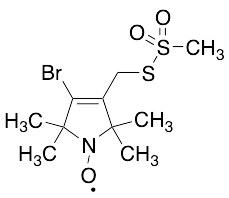
- structure.search.product.name 4-Bromo-(1-oxyl-2,2,5,5-tetramethyl-∆3-pyrroline-3-methyl) Methanethiosulfonate
- Product Code: TRC-B686290
- CAS Number: 215956-55-1
- Brand: TRC
Product Overview
Product Code
TRC-B686290
CAS Number
Product Format
Neat
Molecular Formula
C10 H17 Br N O3 S2
Molecular Weight
343.28
Documentation
Looking for another lot?
To view all certificates of analysis immediately, please login to your account
or
Email download link
{{ errors.first('RequestCoaForm.lotNumber') }}
{{ errors.first('RequestCoaForm.requestEmail') }}
For information about our data processing activities, please visit our Privacy Notice.
Enter your email address and we'll email you the relevant CoA for lots:
{{ coaPopupData.packSize.coaSelectedLotNumbers }}
{{ errors.first('SendDownloadCoaLinkForm.coaEmail') }}
We will be sending the CoA to your email address {{ coaEmailPopupData.userEmail }}
Your request has been sent to our sales team to process.
Find an SDS for your region
{{ errors.first('RequestSdsForm.selectedRegion') }}
{{ errors.first('RequestSdsForm.sdsEmail') }}
For information about our data processing activities, please visit our Privacy Notice.
Your request has been sent to our sales team to process.
Product Information
Chemical Data
Analyte Name
4-Bromo-(1-oxyl-2,2,5,5-tetramethyl-delta-3-pyrroline-3-methyl) Methanethiosulfonate
CAS Number
215956-55-1
Molecular Formula
C10 H17 Br N O3 S2
Molecular Weight
343.28
Accurate Mass
341.9833
SMILES
CC1(C)N([O])C(C)(C)C(=C1Br)CSS(=O)(=O)C
InChI
InChI=1S/C10H17BrNO3S2/c1-9(2)7(6-16-17(5,14)15)8(11)10(3,4)12(9)13/h6H2,1-5H3
IUPAC
3-bromo-1-?^{1}-oxidanyl-2,2,5,5-tetramethyl-4-(methylsulfonylsulfanylmethyl)pyrrole
Product Data
Storage Temperature
-20°C
Shipping Temperature
Room Temperature
Country of Origin
CANADA
Product Format
Neat
Product Description
The Bromo-analogue of MTSL, a highly reactive thiol-specific spin-label. A specific conformational probe of thiol site structure by virtue of its minimal rotational freedom and distance from the covalent disulfide linkage to the macromolecule under study.
References: Berliner, L.J., et al.: Analytical Biochemistry, 119, 450 (1982)
{{title}}
Please login or register to add to your favourites
Or continue browsing without access to favourites or pricing
Please log in to view pricing and add to cart
Or continue browsing to see available rounds without pricing information
If you don't yet have an account, please create an account create an account
- Product Code:
{{ isMultiplePacksize(product) ? getSourcePart(product) : product.code }} {{ isMultiplePacksize(product) ? getSourcePart(product) : product.code }}
Controlled product
Login to view full product details
{{ addToCartData.mixPtRmWarning }}
Do you want to proceed?
{{ errors.first('requestQuoteForm.firstName') }}
{{ errors.first('requestQuoteForm.lastName') }}
{{ errors.first('requestQuoteForm.email') }}
{{ errors.first('requestQuoteForm.phoneCountryCode') }}
{{ errors.first('requestQuoteForm.phoneNumber') }}
{{ errors.first('requestQuoteForm.company') }}
{{ errors.first('requestQuoteForm.selectedShippingAddress') }}
{{ errors.first('requestQuoteForm.shippingCompanyName') }}
{{ errors.first('requestQuoteForm.shippingLine1') }}
{{ errors.first('requestQuoteForm.shippingCountry') }}
{{ errors.first('requestQuoteForm.shippingState') }}
{{ errors.first('requestQuoteForm.shippingCity') }}
{{ errors.first('requestQuoteForm.shippingPostCode') }}
{{ errors.first('requestQuoteForm.billingCompanyName') }}
{{ errors.first('requestQuoteForm.billingLine1') }}
{{ errors.first('requestQuoteForm.billingCountry') }}
{{ errors.first('requestQuoteForm.billingState') }}
{{ errors.first('requestQuoteForm.billingCity') }}
{{ errors.first('requestQuoteForm.billingPostCode') }}
{{ errors.first('requestQuoteForm.deliveryCountry') }}
{{ errors.first('requestQuoteForm.packSize') }}
{{ errors.first('requestQuoteForm.quantity') }}