In this guide
- What are pesticides and why do we use them?
- How pesticides can harm the environment
- The human health risks of pesticides
- Pesticide regulation has steadily increased
- Dangerous pesticides are still widely used
- Pesticide residue testing can keep food safe
- Can pesticide mixtures lead to worse health outcomes?
What are pesticides and why do we use them?
The United States Environmental Protection Agency (USEPA) defines a pesticide as "any substance or mixture of substances intended for:
- preventing, destroying, repelling or mitigating any pest.
- use as a plant regulator, defoliant, or desiccant.
- use as a nitrogen stabilizer" (i.e., to retain nitrogen in soils).
The European Union (EU) adds that "pesticides" describes a diverse range of products – including herbicides, fungicides, insecticides, and rodenticides. But what they have in common is that their active substance "has action against 'pests' or on plants."
For example, many insecticides kill by acting on an insect's nervous system while an anticoagulant rodenticide interferes with the normal clotting of a rodent's blood, causing death by internal bleeding.
As well as an active ingredient, pesticides can include chemical safeners and synergists. These are used respectively to reduce the phytotoxic effects of the pesticide on certain plants, or to enhance the effectiveness of the active substance.
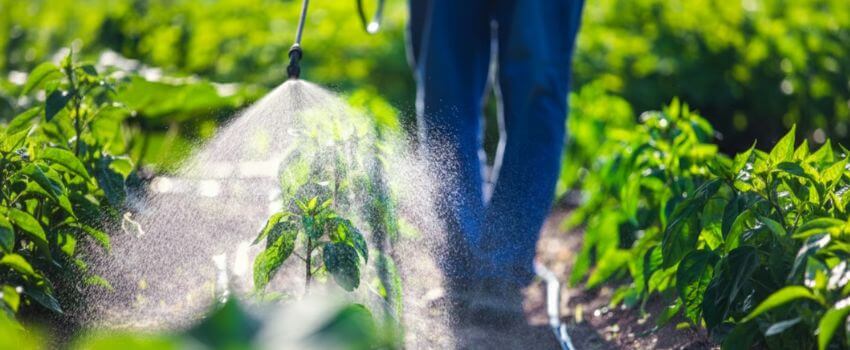
Today, around two million tons of pesticides are applied to crops around the world each year – about 50% more than in the 1990s. There are also around 1,000 different pesticide products in use. Despite worries about the effects of pesticide exposure on humans and the environment, it is widely accepted that they are necessary for maximising harvests and feeding an ever-growing human population.
By 2050, there are expected to be 9.7 billion people on Earth – 30% more than in 2017. Providing for them all will therefore depend on "either increases in yields and/or the number of times each year crops can be grown on the same land." As one study puts it, this "continuous development of agriculture intensifies the application of pesticides globally" – in order to reduce crop losses, increase productivity and enhance product quality.
How pesticides can harm the environment
The modern environmental movement first found its voice with the publication of Rachel Carson's anti-pesticide exposé Silent Spring in 1962. Since then, it has successfully harnessed the power of activist groups, scientific research, and influential media organisations to publicise the dangers of pesticides and other contaminants. A number of research studies about pesticides' detrimental effects have been widely reported. These include a survey of 2,000 hectares of farmland in the UK, Germany and Hungary which confirmed that neonicotinoid insecticides (NNIs) "negatively affect pollinator health under realistic agricultural conditions."
In 2023, a report from more than 50 researchers, using a uniquely large dataset, named pesticide use as a key factor behind huge reductions in bird numbers across Europe. And last year, a pioneering international study found pesticides were causing "pervasive negative impacts" across the whole spectrum of species found in nature. It concluded that over 800 microbe, fungi, plant, insect, fish, bird and mammal species were being harmed by pesticides, many of them unintentionally.
In recent years, researchers have also identified widespread pesticide contamination of European alpine environments, revealed that fipronil and imidacloprid-based pet treatments are polluting UK rivers, and detected high incidence of pesticide residues In Ghanaian vegetables and irrigation waters.
The human health risks of pesticides
As the World Health Organisation (WHO) explains, "pesticides are intrinsically toxic". It adds that they "can have both acute and chronic health effects, depending on the quantity and ways in which a person is exposed." Just how toxic a pesticide is depends on various factors. For example, insecticides tend to be more harmful to humans than herbicides. And individual chemicals can have different effects depending on how much of them people are exposed to, as well as how they are exposed.
Those at greatest risk from pesticides often come into contact with them at work. A study published in npj Parkinson's disease suggests that people exposed to agricultural chemicals exhibited genetic variations that "may generate an underlying susceptibility for developing (Parkinson's) with pesticide exposure." A wide-ranging US study concluded in 2024 that exposure to agricultural pesticides was associated with an increase in cancer risk "comparable to smoking for some cancer types." In a study the same year, more than a third of Asian farmers interviewed said they had experienced symptoms of illness after pesticide exposure. These included dizziness, headache, excessive sweating, vomiting, blurred vision and skin rashes. Meanwhile, research published last year in America reported that living near a golf course could also increase the risk of developing Parkinson's.
Pesticide regulation has steadily increased
WHO states that "None of the pesticides currently authorized for use on food in international trade are genotoxic", and that adverse effects only occur if they are used in unsafe ways.
Its first objective is therefore "to ban the pesticides that are most toxic to humans, as well as pesticides that remain for the longest time in the environment". Secondly, WHO seeks "to protect public health by setting maximum limits for pesticide residues in food and water," commonly referred to as MRLs.
As a result, global standards on safe, maximum pesticide residues for foods and feeds have been agreed, and promulgated by the Codex Alimentarius Commission. Various national, and supra-national, organisations have also been tasked with administering pesticide regulations. These include USEPA (which sets "tolerances" for the maximum amount of a pesticide allowed to remain "in or on a food" in America), China's Ministry of Agriculture and Rural Affairs (MARA), the EU's European Food Safety Authority (EFSA), and various bodies supervised by Brazil's Ministry of Health.
A number of significant new regulations have also been introduced in different parts of the world in recent years – aimed at reducing the risks that pesticides pose to people and the environment. In Europe, the campaign against NNIs has already led to prohibitions on farmers using imidacloprid, clothianidin, thiamethoxam, and thiacloprid – a move that may already be helping insect-eating bird populations to recover. European Commission leader Ursula von der Leyen has also promised to revisit ambitious plans to halve pesticide use across the EU, after they were derailed last year by farmers' protests and Ukraine war-related concerns about food security. Also last year, the UK government announced that it would "dynamically align" with the EU on pesticide regulations after a period of divergence that followed its exit from the bloc, as well as reversing a controversial policy that had permitted the emergency use of NNIs in every year since Brexit. Britain also announced its first-ever pesticide reduction target, with the aim of lowering use on British farms by 10% by 2030, as well as pledging to address "growing concerns" about the amount of fipronil and imidacloprid in the nation's waterways.
In the US, the debate on whether to ban neonicotinoid insecticides has raged for several years – with no action yet taken at federal level, but New York, New Jersey, Maryland, Maine, and Connecticut all imposing their own restrictions on non-agricultural use.
In Asia, India announced new MRLs for pesticides used on tea plants – including mamectin benzoate, fenpyroximate, hexaconazole, and propiconazole. It also ordered laboratories to test products for 20 banned insecticides, and told growers not to use any pesticide that does not have a label claim for tea. South Korea meanwhile introduced a national 'positive' MRL list for pesticide residues in imported foodstuffs, and revised its pesticide tolerance standards for agricultural products.
LGC Standards – quality and innovation in pesticide testing
For more than 50 years, LGC Standards companies have built a worldwide reputation for consistently developing quality pesticide reference materials, research chemicals, and proficiency testing schemes.
Globally, we offer almost 6,000 pesticide products that help laboratories around the world keep our food and environment safe. Our Quality is demonstrated by the fact that more than half are ISO 17034-accredited - and 100% are either accredited to ISO 17034, or produced under our manufacturing sites' ISO 17025 certifications. What's more, all of our ISO 17034 RMs are supplied with comprehensive Certificates of Analysis - guaranteeing that your product is a completely known quantity and giving you supreme confidence in your results.
Our commitment to constant innovation inspired our skilled scientists to develop the unique Smart Solutions™ v700 LC PestiMix Kit– the largest mix of pesticide analytes to be found anywhere on the market. Combining more than 700 analytes for liquid chromatography in only 10 ampoules, PestiMix not only greatly reduces the risk of error for laboratories, but additionally removes the need for complicated method development and dilution steps. We're also proud to have originated the ISO 17034-accredited Smart Solutions™ v400 GC PestiMix Kit to enable the rapid testing of over 400 analytes via gas chromatography.
Our portfolio adapts constantly to reflect ever-changing regulatory demands in an increasingly globalised world – enabling us to launch around 100 new products over the last year for testing pesticides in foods, beverages, and the environment. The full LGC Standards pesticide products range also features more than 900 research chemicals, which are ideal for studies into pesticides in food and the environment, as well as 20+ proficiency testing samples, featuring a wide range of analytes and matrices.
|
Dangerous pesticides are still widely used
WHO also declares that all "Food that is sold or donated.... should comply with pesticide regulations, in particular with maximum residue limits". It also states that use of food pesticides should "comply with good agricultural practices… regardless of the economic status of a country." Therefore, all farmers should ideally "limit the amount of pesticide used to the minimum necessary to protect their crops".
WHO's aspirations are not always being met in practice, however. This is firstly because pesticide MRLs for foods and feeds are often very different in developed and developing countries, with first-world countries tending to adopt more stringent limits.
In addition, farmers in many developing countries are continuing to use pesticides that have been banned due to health concerns in markets like the EU and US. For example, the organophosphate insecticide chlorpyrifos is now largely banned in Europe and North America. However, it "is still being applied in China, India, and many other countries of the Global South."
According to a Belgrade University study, around a third of the 475 new pesticides approved in Brazil in 2019 contained active substances that have been banned or restricted in the EU, while Kenya has registered 51 active ingredients prohibited in Europe. A report on pesticide use in India, Bangladesh, Vietnam and Laos found that the "majority of pesticides being used... are considered as Highly Hazardous Pesticides (HHPs) or banned in one or more countries." Another study published in the journal Environmental Research detected chlorpyrifos and chlorpropham (the latter banned in the EU and largely restricted in the US) in "most" of the cereal, vegetable, fruit, and animal-based foods samples it sourced from markets in two Indian cities. Finally, the Endocrine Society reported that agricultural use of the insecticide DDT "may still be occurring in countries such as India, Ethiopia, and Ghana", despite being prohibited under the Stockholm Convention.
As the authors of the Belgrade report argue, differences in pesticide uses and regulations not only cause trade issues between nations, but pose significant health risks to food consumers. This is because "food containing residues of banned pesticides is frequently reimported back to the countries that allow their production and export, contributing to a global pesticide exposure risk." Activists have meanwhile demanded that first-world countries take action to stop the export of pesticides that are outlawed in their own territories – calling their continued sale abroad a "blatant, obvious double standard."
Pesticide residue testing can keep food safe
The good news – at least for first world consumers - is that rigorous pesticide residue testing appears to be keeping them largely safe from goods that contain banned pesticides or exceed MRLs. But constant vigilance is required, as pesticides continue to be found in a small but worrying number of foods, particularly those imported from abroad.
Europe's Rapid Alert System for Food and Feed (RASFF) is responsible for sharing information about food and feed safety hazards amongst EU member states. It first reported in 2021 that "notifications for imported food regarding unauthorised pesticides have soared." But rather than being a short-lived problem, banned or excessive pesticides in imported foods have remained a significant cause of safety alerts in the years since.
According to RASFF's most recent report, pesticides remained the most common safety issue in fruit and vegetable imports to Europe in 2024. They were also the main problem cited for the cereal and bakery products category, as well as in herbs and spices. In fruit and vegetables, EU-banned insecticides like chlorpyrifos and dimethoate were among "the most prevalent pesticide residues" found. And in herbs and spices, pesticides accounted for 46% of all safety alerts.
The most recent sampling survey from the US Food and Drug Administration (FDA) also confirmed that the developed world has a problem with pesticides in food imports. In this case, pesticide residue testing found that foods brought in from abroad were almost five times more likely to violate tolerance levels than domestically produced goods. For example, almost half of all imported plums that the FDA analysed proved non-compliant.
Can pesticide mixtures lead to worse health outcomes?
Another ongoing issue with pesticides in foods is the frequent presence of multiple pesticide residues. For example, RASFF reported that vine leaf cases analysed in 2024 frequently contained "more than 10 residues of different pesticides". As a new LGC whitepaper on pesticide residue testing points out, the now common practice of using pesticide mixes on food products, combined with the diverse nature of modern diets, has become a concern for both consumers and regulators.
Studies suggest that exposure to several pesticides at the same time can add up – and in some cases interact in more complex ways – to produce effects that are not seen when pesticides are considered one by one. Could the "multiple hit" from pesticide mixtures therefore trigger toxic mechanisms that interact over time, and lead to more negative health outcomes?